Workshop Description
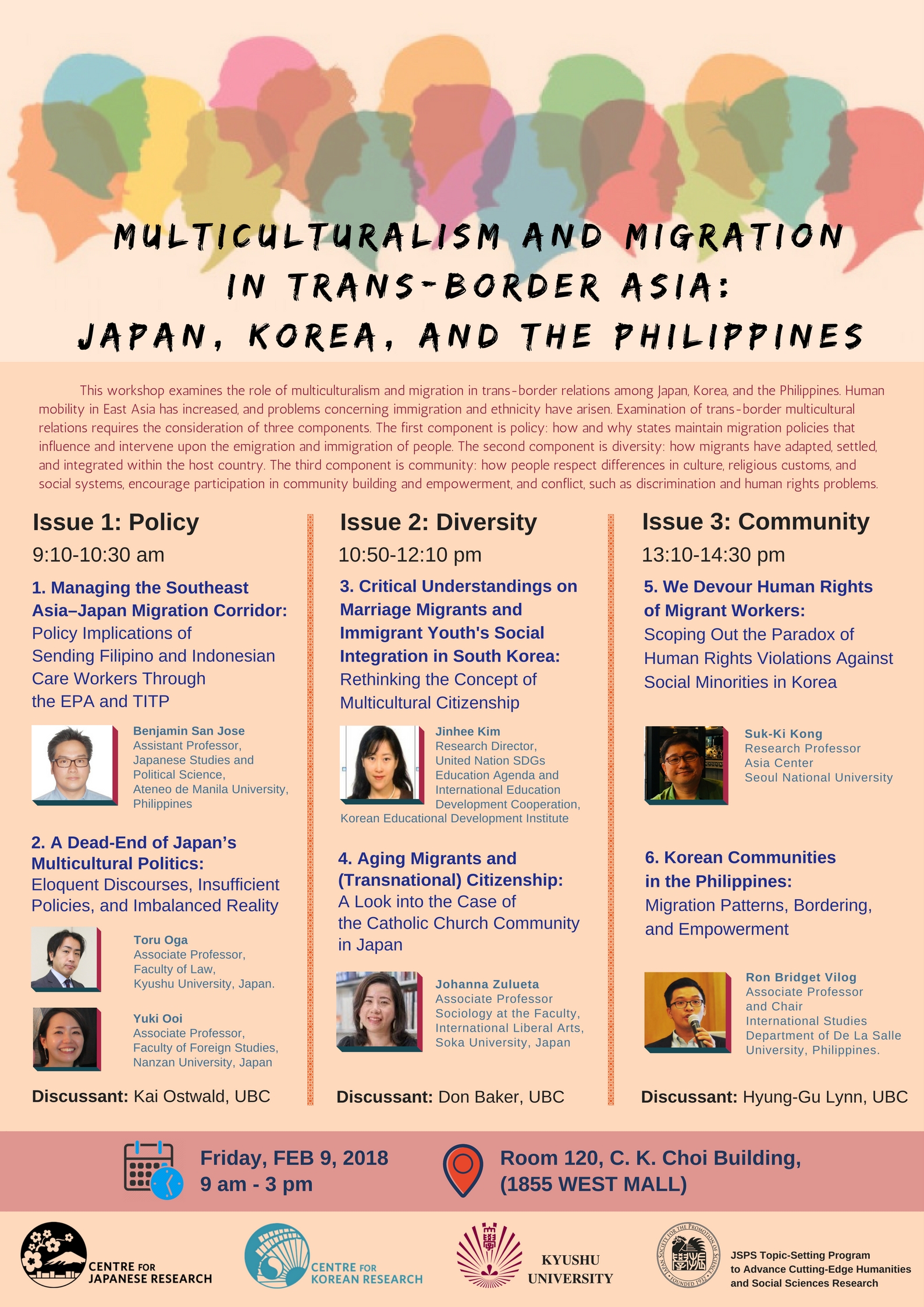
< p>This workshop examines the role of multiculturalism and migration in tran s-border relations among Japan\, Korea\, and the Philippines. Human mobilit y in East Asia has increased\, and problems concerning immigration and ethn icity have arisen. Examination of trans-border multicultural relations requ ires the consideration of three components. The first component is poli cy: how and why states maintain migration policies that influence and intervene upon the emigration and immigration of people. The second compone nt is diversity: how migrants have adapted\, settled\, and integra ted within the host country. The third component is community: how people respect differences in culture\, religious customs\, and social sys tems\, encourage participation in community building and empowerment\, and conflict\, such as discrimination and human rights problems.Timetable
9:00-9:10 Welcome & Introduction
9:10-10:30 Issue 1: Policy
10:30-10:50 Coffee Break
10:50-12:10 Issue 2: D iversity
12:10-13:10 Lunch Break
13:10-14:30 Issue 3: Community
14:30-14:50 General Discussion
14:50-15:00 Closing Remark
< p> The PapersIssue 1: Poli cy
Japan began to receive care workers through its EPAs and recently through the Technical Internship Training Program (TITP). Focusing on the role of recruitment agencies and brokers\, this study argues that the migra tion industry views the inclusion of care workers in the TITP. It is throug h the discourse of “managing” the healthcare migration corridor that broker s and bureaucracies present a veneer of protection and the promise of techn ology transfer even as it maintains the facade of Japanese ethnic homogenei ty.
Japan has traditionally maintained a closed immigration policy that prevent s unskilled laborers from settling. However\, the Japanese government has a ctively formulated various discourses on multiculturalism. Local government s in Japan have initiated numerous multicultural efforts. This paper examin es and compares the policy and discursive practices of an unbalanced and co ntradictory multiculturalist ideology in Japan.
Issue 2: Dive rsity
Although the Korean government has been ag gressively implementing a multicultural integration policy since 2006\, it is hard to deny the growing anti-multicultural sentiment and racism against marriage migrants and immigrant youths in schools and communities and on t he street. This paper will examine both the formal and informal dimensions of the challenges and issues of migration and social integration.
This paper focuses on transnational citizenshi p and aging migrants in Japan and examines how (transnational) citizenship is being enacted or enabled within the Catholic Church community and among these women. This study aims to re-think notions of citizenship and hopes t o challenge ways of looking at aging migrants and their communities.
Issue 3: Community
Despite such fascinating discourses as the migrant era\, mul ticultural society\, and global citizens\, Korean society is faced with ser ious human rights violations taking place in rural areas\, where migrant wo rkers are treated as modern slaves. This paper explores why and how politic al\, economic\, and socio-cultural obstacles hinder local farmers from soci alizing human rights.
This paper examines how Korea n communities exhibit ethnic bordering in a transnational space and explore s the migration dynamics and patterns of Koreans who have been residing in the Philippines. It examines the mechanisms of clustering and their strateg ies of migrant empowerment.
Panelists
Benjamin San Jose is Assistant Professor of Japanese Studies and P olitical Science at the Ateneo de Manila University\, Philippines. He compl eted his doctorate degree in International Public Policy at the University of Tsukuba\, Japan. His research interests include the political economy of Philippine migration and he is currently doing research on the role of the migration industry in managing the Philippine–Japan migration corridor.
Toru Oga is Associate Profess or of Faculty of Law at Kyushu University\, Japan. He completed his Ph.D. i n Ideology and Discourse Analysis at the University of Essex\, United Kingd om. His research interests include international relations in East Asia\, e specially their impact of non-state and transnational actors\, as well as p olicy and discourses on immigration and foreign residents in Japan and the internationalization of local communities.
Yuki Ooi is Associate Professor of Faculty of Foreign Studies at Nanzan Univ ersity\, Japan. She completed her Ph.D. in Sociology at Hitotsubashi Univer sity\, Japan. Her special interests are in migration\, in particular from A sia to the United States in the late nineteenth century\, and cultural and political impacts of globalization of steamship networks on the United Stat es and Japan.
Jinhee Kim is a research director for the United Nation SDGs education agenda and Intern ational Education Development Cooperation at the Korean Educational Develop ment Institute. She completed her Ph.D. at the University of Surrey\, Unite d Kingdom. She has studied and researched in Canada (University of Toronto) \, Germany (Siegen University)\, Australia (University of Technology Sydney )\, and South Africa (University of Free State)\, and UNESCO Headquarters i nvited her to become a member of the EAG (expert advisory group) for Global Citizenship Education.
Johanna Zulu eta is Associate Professor of Sociology at the Faculty of Internat ional Liberal Arts\, Soka University\, Japan. She completed her Ph.D. in So ciology at Hitotsubashi University\, Japan. She is the author of numerous a rticles on Japan–Philippines migrations\, primarily on military basing and migration in Okinawa. She is the editor of Thinking Beyond the State: M igration\, Integration\, and Citizenship in Japan and the Philippines (Manila: De La Salle University Publishing House\, 2018).
Suk-Ki Kong is Research Professor in the Asi a Center at Seoul National University. He studied sociology and completed b oth a B.A. and M.A. in the Department of Sociology at SNU. He received his Ph.D. from the Department of Sociology at Harvard University. His major fie lds of research are social movements\, NGO studies\, and political sociolog y. He currently works on two research projects\, “Korean Citizen’s Engageme nt in Social Economy” and “Comparing Corporate Social Responsibility (CSR) Activities in Local Community between Korea and Japan.”
Ron Bridget Vilog is Associate Professor and c urrently Chair of the International Studies Department of De La Salle Unive rsity\, Philippines. He completed his Ph.D. in International Development fr om the Graduate School of International Development (GSID)\, Nagoya Univers ity\, Japan. His research focus includes ethnicity-based migration\, explor ing the case of Filipino nikkeijin in Japan.
Discussa nts: Kai Ostwald (UBC)\, Don Baker (UBC)\, and Hyung-Gu Lynn (UBC)