
Virtual Book Launch – Agents of World Renewal: The Rise of Yonaoshi Gods in Japan
Description
The Centre for Japanese Researc h (CJR) at the University of British Columbia presents a series of online b ook launches to celebrate recent publications about premodern Japan. For ou r November event\, author Takashi Miura will be discussing Agents of Wo rld Renewal: The Rise of Yonaoshi Gods in Japan in conversation with G ideon Fujiwara and Gennifer Weisenfeld.
Featuring
• Takashi Miura (University of Arizona)
• (Interlocutor) Gideon F
ujiwara (University of Lethbridge)
• (Interlocutor) Gennifer Weisenfel
d (Duke University)
Time
Friday\, November 20\,
2020 6-7:15PM in Pacific Time (US and Canada)
Friday\, November 20\,
2020 9-10:15PM in Eastern Time (US and Canada)
Saturday\, November 21\
, 2020 10-11:15AM in Japan Time
Registration
< a href="https://ubc.zoom.us/meeting/register/u5wsf-GtrTorHtDG8zSq5Nqd_FVB1I BDGtzZ">https://ubc.zoom.us/meeting/register/u5wsf-GtrTorHtDG8zSq5Nqd_FVB1I BDGtzZ
Note
If you do not receive an email with access details by the day before the event\, please email bianca.chui@ubc.ca
For disability accomm odations\, questions\, or concerns\, please either email bianca.chui@ubc.ca.
We can also be reached via Twitter @ubcCJR
Takashi Miura is an Associate Pro fessor in the Department of East Asian Studies at the University of Arizona . His research focuses on Japanese religions in the early modern and modern periods. He received his BA and MA from the University of Hawai’i at Mānoa and his PhD from Princeton University.
Gideon Fujiwara is an Associate Professor in the Department of History at the University of Lethbridge\, where he als o serves as the coordinator of Asian Studies. Gideon studies the history of early modern to modern Japan\, focusing on the themes of community and nat ion\, kokugaku (Japan studies)\, and waka poetry. His fir st book\, From Country to Nation: Ethnographic Studies\, Kokugaku\, and Spirits in Nineteenth-Century Japan\, is forthcoming from Cornell Uni versity Press\, Cornell East Asia Series in May 2021.
Gennifer Weisenfeld is a Professor in the Department of Art\, Art History\, and Visual Studie s at Duke University and she received her Ph.D. from Princeton University. Her field of research is modern and contemporary Japanese art history\, des ign\, and visual culture. Her first book Mavo: Japanese Artists and the Avant-Garde\, 1905-1931 (University of California Press\, 2002) addre sses the relationship between high art and mass culture in the aesthetic po litics of the avant-garde in 1920s Japan. And her second book Imaging D isaster: Tokyo and the Visual Culture of Japan’s Great Earthquake of 1923 (University of California Press\, 2012\, Japanese edition Seidosha\, 20 14) examines how visual culture has mediated the historical understanding o f Japan’s worst national disaster of the twentieth century. She is the gues t editor of the special issue Visual Cultures of Japanese Imperialism of the journal positions: east asia cultures critique (Winter 2000) that includes her essay\, “Touring ‘Japan as Museum’: NIPPON and Other Japanese Imperialist Travelogues.” She has also written extensiv ely on the history of Japanese design\, such as\, “‘From Baby’s First Bath’ : Kaō Soap and Modern Japanese Commercial Design” (The Art Bulletin\, September 2004) and the core essay on MIT’s award-winning website V isualizing Cultures on the Shiseido company’s advertising design. She has just completed a new book project titled Gas Mask Nation: Visualizi ng Civil Air Defense in Wartime Japan.
Agents of World Renewal: The Rise of Yonaoshi Gods in Japan
Published by Un iversity of Hawai’i Press
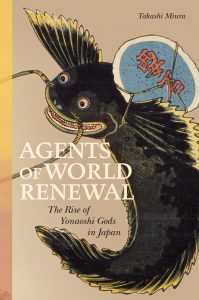 This volume
examines a category of Japanese divinities that centered on the concept of
“world renewal” (yonaoshi). In the latter half of the Tokugawa peri
od (1603–1867)\, a number of entities\, both natural and supernatural\, cam
e to be worshipped as “gods of world renewal.” These included disgruntled p
easants who demanded their local governments repeal unfair taxation\, gover
nment bureaucrats who implemented special fiscal measures to help the poor\
, and a giant subterranean catfish believed to cause earthquakes to punish
the hoarding rich. In the modern period\, yonaoshi gods took on more
explicitly anti-authoritarian characteristics. During a major uprising in
Saitama Prefecture in 1884\, a yonaoshi god was invoked to deny the
legitimacy of the Meiji regime\, and in the late nineteenth and early twent
ieth centuries\, the new religion Ōmoto predicted an apocalyptic end of the
world presided over by a messianic yonaoshi god.
This volume
examines a category of Japanese divinities that centered on the concept of
“world renewal” (yonaoshi). In the latter half of the Tokugawa peri
od (1603–1867)\, a number of entities\, both natural and supernatural\, cam
e to be worshipped as “gods of world renewal.” These included disgruntled p
easants who demanded their local governments repeal unfair taxation\, gover
nment bureaucrats who implemented special fiscal measures to help the poor\
, and a giant subterranean catfish believed to cause earthquakes to punish
the hoarding rich. In the modern period\, yonaoshi gods took on more
explicitly anti-authoritarian characteristics. During a major uprising in
Saitama Prefecture in 1884\, a yonaoshi god was invoked to deny the
legitimacy of the Meiji regime\, and in the late nineteenth and early twent
ieth centuries\, the new religion Ōmoto predicted an apocalyptic end of the
world presided over by a messianic yonaoshi god.
Using a vari ety of local documents to analyze the veneration of yonaoshi gods\, Takashi Miura looks beyond the traditional modality of res earch focused on religious professionals\, their institutions\, and their t exts to illuminate the complexity of a lived religion as practiced in commu nities. He also problematizes the association frequently drawn between the concept of yonaoshi and millenarianism\, demonstrating that yonao shi gods served as divine rectifiers of specific economic injustices an d only later\, in the modern period and within the context of new religions such as Ōmoto\, were fully millenarian interpretations developed. The scop e of world renewal\, in other words\, changed over time.
Agents of World Renewal approaches Japanese religion through the new analytical lens of yonaoshi gods and highlights the necessity of looking beyond the boundary often posited between the early modern and modern periods whe n researching religious discourses and concepts.
Available for purchase from the University of Hawai’i Press (United States) and UBC Press (Canada) in both hardcover and paperback.