



“The true charm of studying Chinese society and politics seems to lie in the fact that it is an enduring mystery—one that can never be fully unraveled in the present moment. It's like a distant shore that, as a scholar, you can never quite reach.”
China’s continuing internal complexity makes the country one in need of updated and unique research methods – where understanding shifting political discourse, legal institutions, and urban life increasingly demands new, data-driven approaches alongside traditional scholarship. The School of Public Policy and Global Affairs (SPPGA) is pleased to welcome Associate Professor Qiang Fu to our core faculty, a scholar dedicated to advancing the understanding of China.
Cross-appointed with the Department of Sociology, Prof. Qiang Fu currently serves as Co-Director of IAR’s Centre for Chinese Research (CCR) and holds the Republic of China Chair. As with nearly all professors from China of his generation, he is a first-generation PhD who grew up witnessing the massive transformation of Chinese society firsthand. His academic journey took him to Jinan University in Guangzhou for a BA in Computer Science, Peking University for an MA in Demography, and finally Duke University for his PhD in Sociology.
We spoke with Qiang about what brought him to SPPGA, what drives his research, and his interests outside of the classroom:
What drew you to UBC and the School of Public Policy and Global Affairs?
After 11 wonderful years with the Department of Sociology, I am thrilled and incredibly fortunate to join SPPGA. Looking back, I’ve always felt that luck has played a far greater role in my journey than raw talent or hard work alone. There is a deep-rooted tradition in Chinese culture of applying what one learns to practical use. For me, joining SPPGA and holding the Republic of China Chair is an opportunity to put that into practice and better serve our community.
As Co-Director of the Centre for Chinese Research, what conversations or collaborations are you hoping to spark at UBC?
I believe the most crucial step is to view the Centre for Chinese Research first and foremost as a platform for open academic exchange and dialogue. It should be a place where scholars and students with diverse backgrounds, experiences, and viewpoints can meet, connect, communicate, and collaborate. In today’s world—one so often fraught with conflict, distrust, and ideological entanglements—building this kind of shared public space is nothing short of a miracle. Ultimately, for every scholar and student who has ever worked, studied, or visited here: wherever you are, that is where our Centre for Chinese Research is.

Your research examines contemporary Chinese society and politics, what gravitates you towards these topics? What about your research is of most interest to you?
I sometimes wonder: if I weren’t from China, and if I didn’t speak Chinese, would I still be drawn to researching China? The true charm of studying Chinese society and politics seems to lie in the fact that it is an enduring mystery—one that can never be fully unravelled in the present moment. It’s like a distant shore that, as a scholar, you can never quite reach. When China’s history, culture, human relations (renqing), traditions, and politics are all so intricately interlocked, researchers embedded in a specific time and space can often only offer answers bounded by their own era. Yet, as scholars, we are deeply driven by the hope to transcend our time and understand Chinese society and politics from a more enduring, theoretical perspective.
Computational sociology and text/data mining are a big part of your toolkit. What can these methods uncover about Chinese politics and society that traditional approaches might miss?
I don’t strongly advocate for “scientism” in China studies—much like the crisis of European sciences that Edmund Husserl pointed out years ago. China’s issues are incredibly complex and fall more into the realm of practical reason. However, computational social science is undeniably helpful in our field. It pushes past the boundaries of traditional research methods, offering new data, evidence, and perspectives that greatly advance our exploration of specific mechanisms or the establishment of new theories. If our goal is to produce research with profound explanatory and critical power, these tools allow us to further verify or falsify the production of knowledge. After all, if a research paper can now be easily generated by AI, we have to ask ourselves: are we still truly producing knowledge?
What are you currently working on? What about it excites you?
At its core, my research is driven by a long-standing question: “What is China?” Yet, the more my academic experience grows, the harder that question becomes to answer. To tackle it, I’ve been deepening my engagement with phenomenology, new institutionalism, traditional Chinese thought (such as Neo-Confucianism), and Chinese history—particularly contemporary and CCP history. Another area that excites my collaborators and me is using computational methods to explore international influences on China since the Opium War, and especially after WWII. We look at how countries like the US and the Soviet Union viewed China at the time, and conversely, how China perceived their impact from its own perspective.
Tell us about a favourite hobby or activity outside of work that you’re passionate about.
Growing up, I was fascinated by stamp and banknote collecting, reading Japanese manga, and playing video games. A couple of years ago, when I finally had some free time, I actually beat Super Mario Bros from start to finish. I was ridiculously excited, even if I’m no longer a wind-chasing teenager.
These days, I’m hoping to get back into the habit of exercising more, much like I did during my university years—especially since every time I travel to East Asia for fieldwork now, I inevitably come back feeling like I’ve gained a few extra pounds!
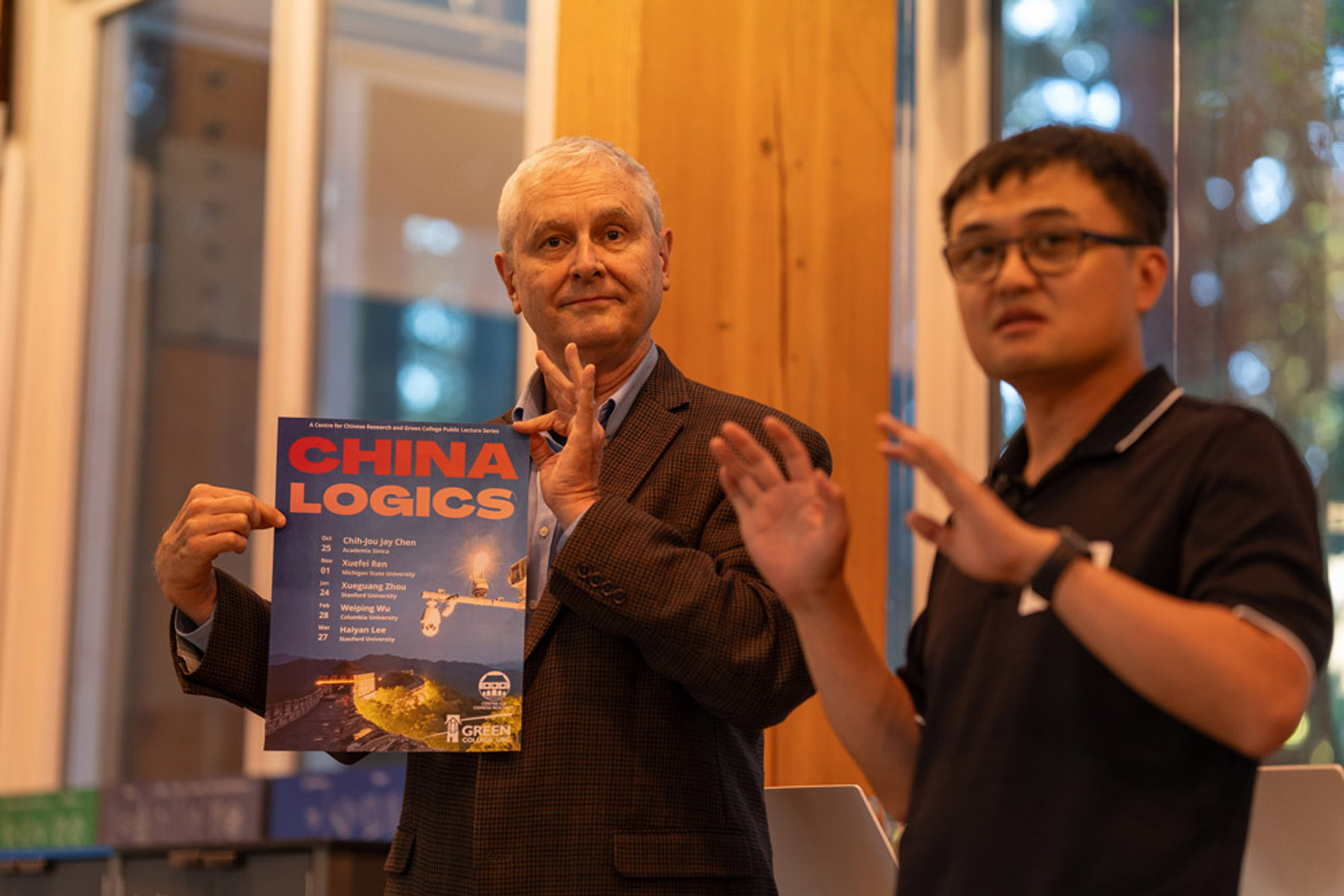
Prof. Qiang Fu and Prof. Timothy Cheek

Centre for Chinese Research

Prof. Qiang Fu

Institute of Asian Research directors


